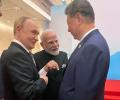
'Personalities are temporary, policies provide for stability.' 'With the former, when personalities change so does the nature of the relationship.' 'Policies and structures, on the other hand, are idiot-proof, as well as maverick-resistant,' explains Saisuresh Sivaswamy.
'Engaging with Pakistan at this stage sends out a message that undermines the sentiments of the people of India who stand firmly against any compromise on national security.'
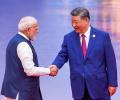
'Xi is an individual led by a harder calculus and would scoff at melting over gestures.' 'That we did not know this was our failure,' asserts Aakar Patel.

Chief of Defence Staff Gen Anil Chauhan identifies China border dispute as India's biggest national security challenge, followed by Pakistan's proxy war. He also highlighted regional instability, future warfare scenarios, and dealing with nuclear-armed adversaries as major concerns.
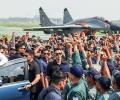
An Indian delegation led by the BJP's Ravi Shankar Prasad will tour key European capitals to expose Pakistan's role in cross-border terrorism and State-sponsored extremism.
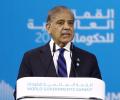
He conveyed this during a telephonic conversation with US Secretary of State Marco Rubio, according to a statement posted by the state-run Pakistan Television on X.
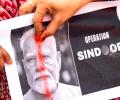
World leaders, including the UN Secretary-General and US President Donald Trump, have urged India and Pakistan to exercise restraint and seek peaceful solutions to the ongoing tensions. The calls for calm come after India conducted airstrikes in Pakistan-occupied Kashmir in response to a recent terrorist attack. Leaders from the US, Russia, UK, China, UAE, Qatar, and Japan have expressed concern over the escalating situation and emphasized the need for dialogue and de-escalation.

'There are times when India should stand up without hesitation and voice its indignation over the US' pressure tactic. This is one such moment,' asserts Ambassador M K Bhadrakumar.
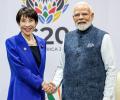
If they act now, they can reshape the strategic map of Asia without firing a shot. If they wait, the next opportunity will come only after a serious Taiwan Strait incident -- by which time the price will be far higher, and the room for boldness far smaller -- the opportunity may well be lost by then. The question is no longer whether this can or should be done, points out Varun Arya.

China on Friday said the Shanghai Cooperation Organisation (SCO) summit to be held in Tianjin later this month will be the largest in the bloc's history, with 20 world leaders, including Prime Minister Narendra Modi, attending it.

Prime Minister Narendra Modi and Chinese President Xi Jinping are set to meet in Tianjin on Sunday, their first in about 10 months, for wide-ranging talks aimed at improving relations.
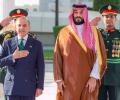
'Saudi-Pak defence pact is to anchor the defence and security of Saudi Arabia and not Pakistan, per se, with Islamabad being the junior partner.'

The National Council of Educational Research and Training (NCERT) is developing a special classroom module on Operation Sindoor to help students learn about India's defence strategy and diplomatic response, according to sources.

Trump's method are more destabilising than his policy. So, a good idea these couple of years is to sip Kool-Aid, and savour the joys of Trumplomacy, asserts Shekhar Gupta.

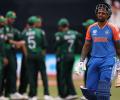
The two sides are set to face each other in the semi-finals of the ongoing World Championship of Legends (WCL), but deepening diplomatic strains and strong public sentiment in India have cast serious doubt on whether the match will actually take place.
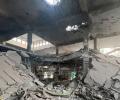
Pakistan has reiterated its desire for normal neighbourly relations with India, while also criticizing India's decision to put the Indus Waters Treaty in abeyance. The Foreign Office spokesperson emphasized Pakistan's commitment to diplomacy and regional cooperation.

Congress leader Priyanka Gandhi Vadra launched a scathing attack on the government regarding the Pahalgam terror attack, questioning intelligence failures and demanding accountability.
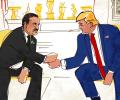
'Trump has personally weighed in to overcome doubts and reservations about Pakistan among his top advisors.'

External Affairs Minister S Jaishankar addresses Parliament on Operation Sindoor, denying any US trade linkage and highlighting Pakistan's request for a ceasefire through the DGMO channel.

External Affairs Minister S Jaishankar discusses India's approach to cross-border terrorism following the Pahalgam attack, emphasizing a firm response and no compromise on nuclear blackmail.
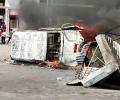
Former Indian ambassadors urge New Delhi to closely monitor the unfolding political crisis in Nepal, citing regional instability and potential implications for India's interests.
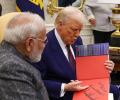
'The current strain in the relationship is serious and likely to be long lasting.' 'Even if Trump suddenly changes his attitude toward India -- which he is entirely capable of doing -- it is unlikely that New Delhi will be able to pick up the pieces and respond as if nothing has happened.'

Congress leader Sonia Gandhi criticizes the Modi government's stance on Palestine, calling it a 'profound silence' and an abdication of humanity and morality. She argues that India needs to demonstrate leadership on the issue and that the government's actions are driven by personal friendship rather than constitutional values or strategic interests.

The ICC has officially asked for a written explanation from BCCI regarding its decision to not send the Indian cricket team to Pakistan.
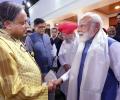
Prime Minister Narendra Modi's energy, dynamism and willingness to engage remains a 'prime asset' for India on the global stage but deserves greater backing, Congress MP Shashi Tharoor said on Monday, in remarks that are likely to irk his party and widen the growing cracks in his ties with its leadership.
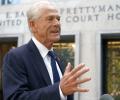
Former White House trade advisor Peter Navarro has criticised India for continuing to procure Russian oil, alleging profiteering and contributing to the Russia-Ukraine war. India defends its energy procurement as driven by national interest and market dynamics.
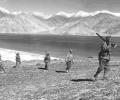
As India and China continue to face off across the Himalayas six decades later, the echoes of that earlier conflict remain unmistakable. The core of China's sensitivity lies not in maps or mountain passes, but in its perception of sovereignty over Tibet, points out Dr Kumar.

A new book reveals that India and Pakistan discussed a communal division of Jammu & Kashmir along the Chenab river before the Kargil war in 1999.

According to the DRDO chairman, the BrahMos missile, primarily launched from Sukhoi Mk 1, was used during the offensive phase.
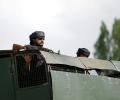
'Whatever we do, the purpose will be to re-establish deterrence.'

The post further read that "at a moment of heightened regional turbulence", President Trump "demonstrated great strategic foresight and stellar statesmanship through robust diplomatic engagement with both Islamabad and New Delhi," Dawn reported.

Mrs Gandhi's power ebbed and peaked with the times. Mr Modi's has almost been constant, barring the few months of hard dip after the 240 seats of 2024, points out Shekhar Gupta.
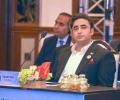
Bhutto, who served as the Foreign Minister earlier, addressed a briefing at the UN Headquarters in New York and sought reconciliation with India, making a plea for talks and Intel sharing between the two neighbours.
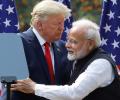
'Trump will absolutely back New Delhi on its position that Pakistan must do more to crack down on terrorists that threaten India.'
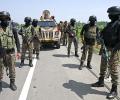
India needs to be technologically and militarily prepared to defend itself from both Pakistan and China, alerts Ramesh Menon.

Iranian Foreign Minister Abbas Araghchi visited Pakistan and called on both India and Pakistan to "exercise restraint" amid rising tensions between the two countries following the Pahalgam terror attack. Araghchi, who is scheduled to travel to India on Thursday, emphasized the importance of easing tensions and preventing further escalation. During his talks with Pakistani officials, Araghchi and Pakistani Foreign Minister Bilawal Bhutto Zardari reaffirmed their commitment to strong Pakistan-Iran ties and agreed to boost cooperation in trade, energy, and connectivity. Both sides also exchanged views on the situation in South Asia and the US-Iran talks, while agreeing that complex regional issues could be resolved through diplomacy and negotiations.

India on Thursday said the issue of trade did not come up at all in talks between Indian and American leaders during its military clashes with Pakistan, virtually rejecting Washington's repeated claims that its offer of trade stopped the confrontation.
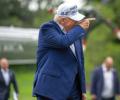
Trump has repeatedly claimed that he "helped settle" the tensions between India and Pakistan and that he told the nuclear-armed South Asian neighbours that America would do a "lot of trade" with them if they stopped the conflict.

By threatening to punish India with high tariff, Trump is actually planting a tantalising thought in the Indian mind that the Modi government should suitably 'incentivise' him, explains Ambassador M K Bhadrakumar.

Former Indian Army chief General Shankar Roychowdhury (Retd) has blamed "intelligence failure" for the recent terror attack in Pahalgam, Jammu and Kashmir, which claimed the lives of 26 civilians. He demanded accountability at the highest levels, stating that there must be someone responsible for the negligence and they must be held accountable for the consequences.
